







Peanut’s Journey with Osteoarthritis and the Assisi Loop
I rarely travel anymore, but it was my niece’s wedding shower, and I didn’t want to miss such a special day. It was a whirlwind trip: arrive in Tampa on Friday evening and head back home to Fort Lauderdale on Sunday morning. Even though it was short, and even though Dan is perfectly capable of managing our six cats, I never feel quite right leaving them. Nothing beats the routine of a mom who knows every single quirk, idiosyncrasy, and “do this, don’t do that, give this one this, and that one that” like the back of her hand.
Aside from the usual travel headaches—like the media hype warning me to get to the airport practically the night before due to security check lines (it took me all of ten minutes) and the fact of it not being a cat-ear-wearing event—I had a wonderful time catching up with family and was glad I made the trip.
Until Dan picked me up from the airport.
I was barely in the car before he told me something was wrong with Peanut. A few hours before coming to get me, he noticed she had a severe limp in her back left leg and was struggling to walk. He didn’t know if she had jumped from somewhere and landed awkwardly, or if it was something worse. Naturally, my stomach dropped for the entire drive home. The “kittens”—Mia, Peanut, and Rolz—are all seventeen years old now, so I live in a constant state of “please don’t let this be it.”
When we walked through the door, Peanut was lying on the couch, which isn’t her usual routine. When we gently placed her on the floor to see how she was moving, she just limped along with this confused, heartbroken look that seemed to ask, “Why is this happening to me?” We immediately put her back on the couch so she wouldn’t strain herself. I knew we’d be at the vet sometime on Monday.
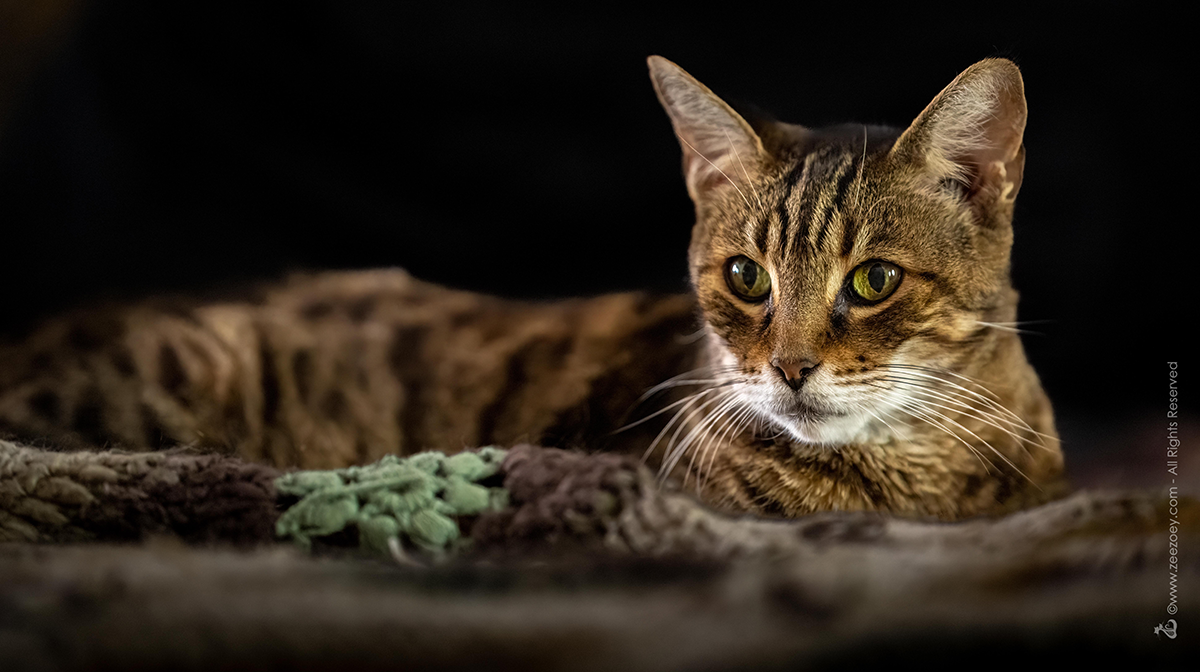
Peanut on the couch
Back in 2023, she had been diagnosed with osteoarthritis—degenerative joint disease—in her left stifle joint. We had discovered it through an X-ray back then because, just like this time, she had randomly started limping one day. According to the Cornell Feline Health Center, about 90% of cats over the age of twelve are affected by osteoarthritis, making it one of the most common chronic diseases our feline companions face. Peanut had clearly been living with it for a while, but it wasn’t visible to us until the limping started.
Our vet recommended Nutramax Cosequin chewable tablets for cats (a joint supplement with Glucosamine, Chondroitin, and Omega-3s) alongside Nutramax Cobalequin B12 to support her immune, nervous, and cognitive systems. We mixed them into her food every day, and honestly, within a couple of weeks, the limp vanished.
She was back to her happy, agile self. But that version of Peanut was gone. Now, she was wobbly, disoriented, and probably in pain. Why didn’t we realize it? Cats are masters at disguising pain, so Peanut’s natural survival instinct was to carry on as normally as possible and make subtle adjustments until it escalated to the point that we noticed it.
When I called the vet Monday morning, I was incredibly grateful they could squeeze us in later that day. After an extensive exam, we got some good news—her weight was stable, and her vitals were strong. However, the new X-ray revealed that Peanut had developed a bone spur on her stifle joint, which was causing her symptoms.
For those who don’t know, the stifle joint is the complex joint in a mammal’s hind limbs that serves as the equivalent to a human knee, joining the femur, patella, and tibia. Bone spurs, or osteophytes, are extra growths of bone tissue that look like smooth lumps. They don’t always cause trouble, but if they press on a nerve or interfere with a joint’s movement, they cause immense pain. With osteoarthritis, you aren’t looking for a cure; you’re looking for a management plan to maximize comfort and minimize suffering.
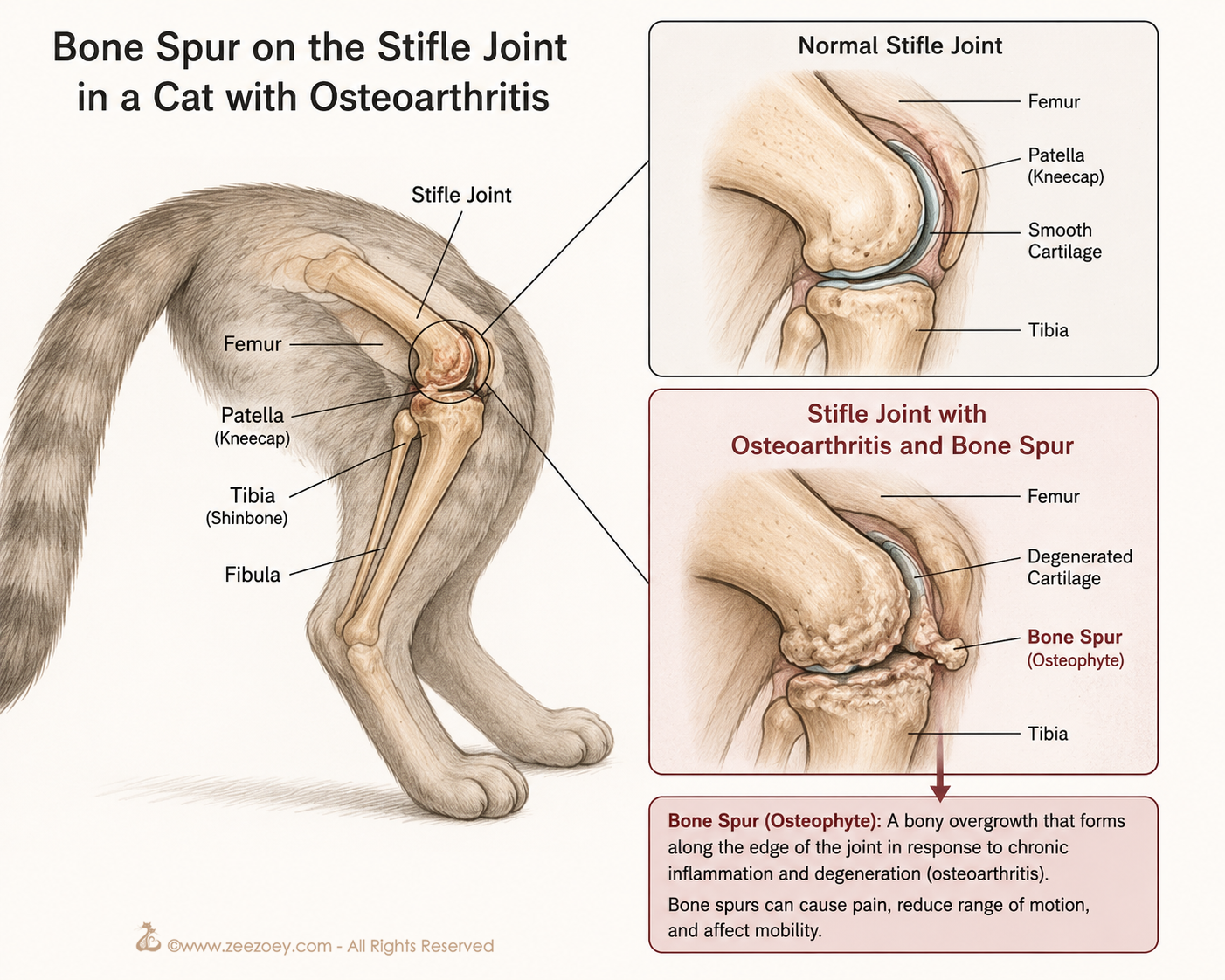
Diagram of a bone spur on the stifle joint in a cat with osteoarthritis
To give us time to figure out a long-term strategy, our priority was immediate pain relief. We started her on a low oral dose of Gabapentin every 12 to 24 hours. The vet also treated her stifle with a non-invasive, low-level cold laser therapy session to reduce inflammation, and even performed acupuncture.
From there, Dan and I had to choose a permanent path forward. Outside of regular visits to the vet for either laser therapy, acupuncture, or a combination of both, the vet gave us two FDA-approved options: a once-a-month Solensia injection or an Assisi Loop device.
Solensia, manufactured by Zoetis, is administered by a vet and works like a cat’s natural antibodies to neutralize Nerve Growth Factor (NGF), blocking pain signals from reaching the brain. The Assisi Loop, manufactured by Zomedica, is a completely drug-free device that uses Targeted Pulsed Electromagnetic Field (tPEMF) technology, emitting imperceptible, low-level bursts of electromagnetic energy directly into damaged tissue to promote healing.
Neither option is cheap, but cost didn’t matter to me—I would do anything for my little girl. What did matter was her quality of life. Except for the loop, the treatments required frequent visits to the vet, which stressed her. Solensia sounded incredible in theory, but it required bloodwork to check her kidneys first, as it isn’t recommended for cats with advanced kidney disease. On the flip side, the Assisi Loop seemed like the ultimate holistic approach, but truth be told, I was skeptical. It sounded a little too good to be true. Was it just a gimmick?
We brought Peanut home and waited for the blood results, hoping for the best. I carried her everywhere, bringing her food dish right to her face so she wouldn’t have to walk. In the back of our minds, we were leaning toward the Solensia injection, but the whole situation felt overwhelming.
And the Gabapentin was just awful. Peanut wasn’t Peanut anymore. The medication made her completely groggy, and her beautiful eyes looked clouded and vacant. We didn’t want her to be in pain, but we couldn’t help but ask ourselves: what kind of life is this? It felt especially cruel because she otherwise received a clean bill of health.
When the vet called with the blood results, we got the green light—Peanut’s kidneys were healthy enough for Solensia. I booked the appointment for her first injection, thinking we would just take it one step at a time. But something kept nagging at Dan and me. We did a mountain of research—especially Dan—and we ultimately decided the risk wasn’t worth the reward. A monthly injection is a massive commitment; if she had an adverse reaction, you can’t just pump it out of her system. Yes, it was FDA-approved in 2022, but are a few years really enough time to accurately assess the available case studies? We read some miraculous success stories, but we also found heart-wrenching accounts of severe complications and even deaths.
I decided to take a leap of faith. I canceled the appointment and ordered an Assisi Loop from Pet Wish Pros. No monthly vet stress, and no terrifying side effects. We had nothing to lose and everything to gain. When it arrived, it looked so strange—a tiny plastic circle containing a battery, attached to a flexible black rubber loop. It comes in 10 cm and 20 cm sizes, and the internal battery lasts for at least 150 fifteen-minute treatments. Looking at it, I remember thinking, how on earth is this actually going to work?
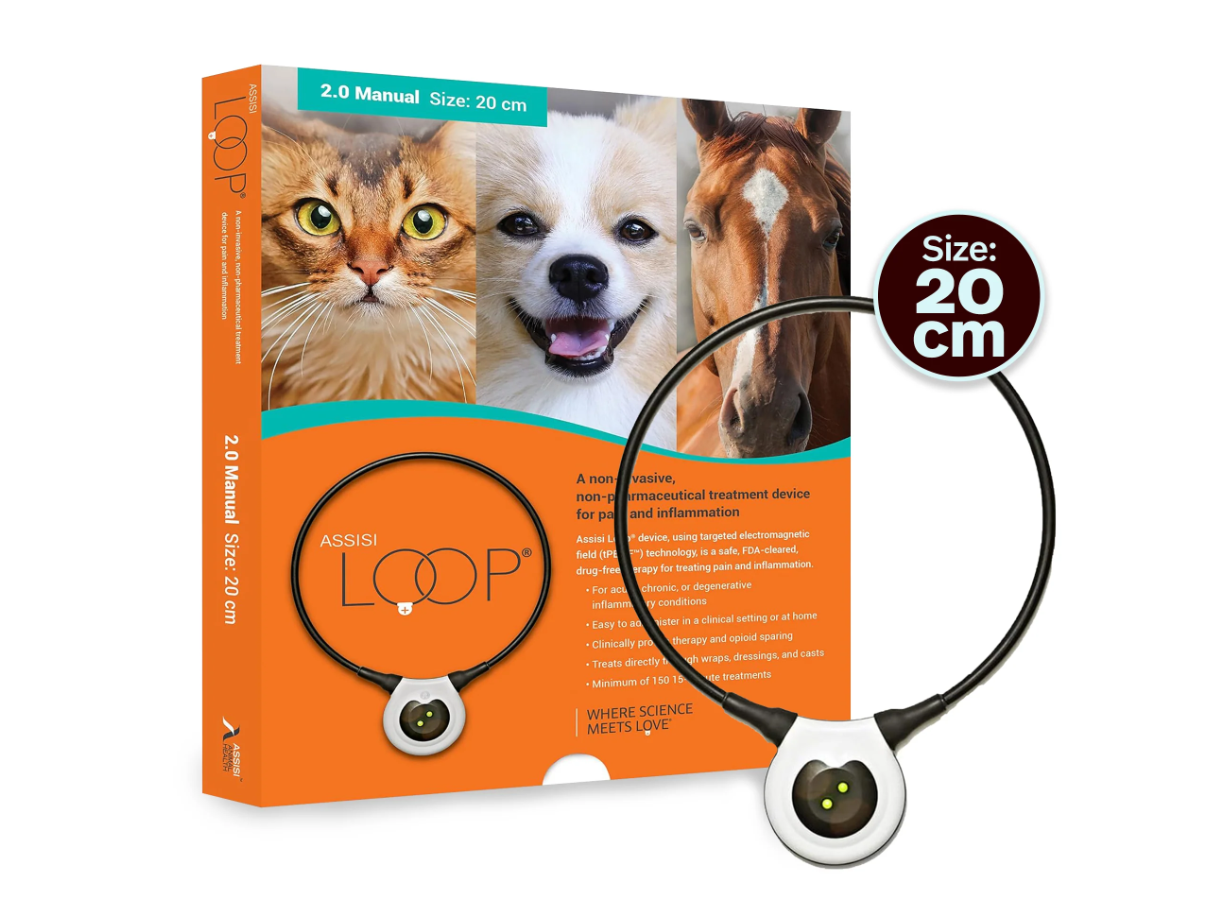
I ordered the 20 cm size to fully encompass Peanut’s stifle joint
I received the loop at the beginning of April, and have faithfully placed it over Peanut’s left stifle joint twice a day, every single day: once in the morning right after her breakfast, and once in the evening after dinner.
It is now June, and I’m about to start our second loop. All I can say is that we have been incredibly blessed. Peanut will never be a kitten again, but she is as “Peanuty” as she can possibly be. She walks a little slower, but the limp is noticeably reduced. Her absolute favorite thing in the world is napping out on our tiki deck, soaking up the warm sunshine, and taking her daily perimeter walks to hunt for bugs and lizards. Thanks to the loop, she is back to her beloved routine—and completely Gabapentin-free.
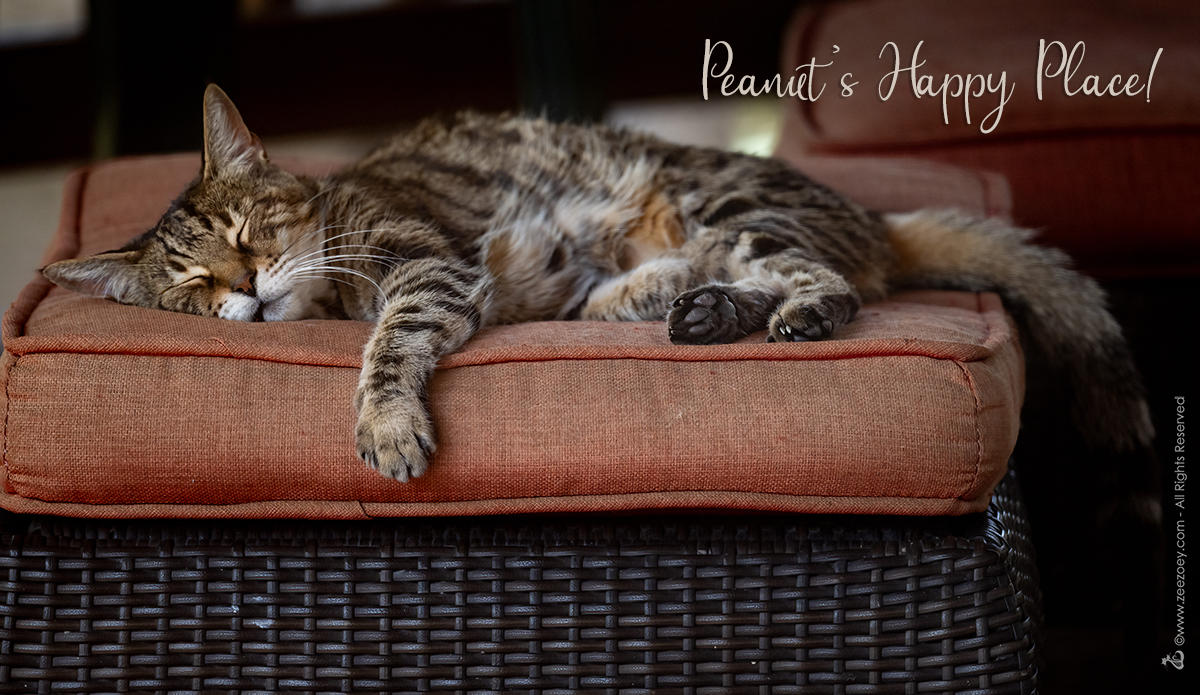
A very relaxed and content Peanut in her beloved tiki
To help her out, I’ve placed a little stepstool outside so she can easily reach her favorite outdoor ottoman, and I put a set of pet stairs inside next to the dining room ottoman where she takes her morning naps.
My favorite part of the day has become her 5:15 a.m. morning treatment. Like clockwork, she heads straight to the dining room ottoman after breakfast. Within minutes of me sitting down with her, she is joined by her siblings, Mia and Rolz. It’s as if they can sense she needs them. They curl their bodies tightly next to her, acting as natural weights to keep the Assisi Loop snugly in place against her leg. I turn on a pet heating pad I purchased on Amazon, on a low, two-hour timer to help soothe her stiff joints (placed under a towel for maximum safety to her skin). I also created steps (from boxes holding my Zee & Zoey books, no less!) to make it easier for her to get onto the ottoman, and sometimes Shadow joins us too, sitting quietly on the bottom step. The house is still dark, the world hasn’t quite woken up yet, and for fifteen minutes it’s just Peanut, Mia, Rolz, and me.
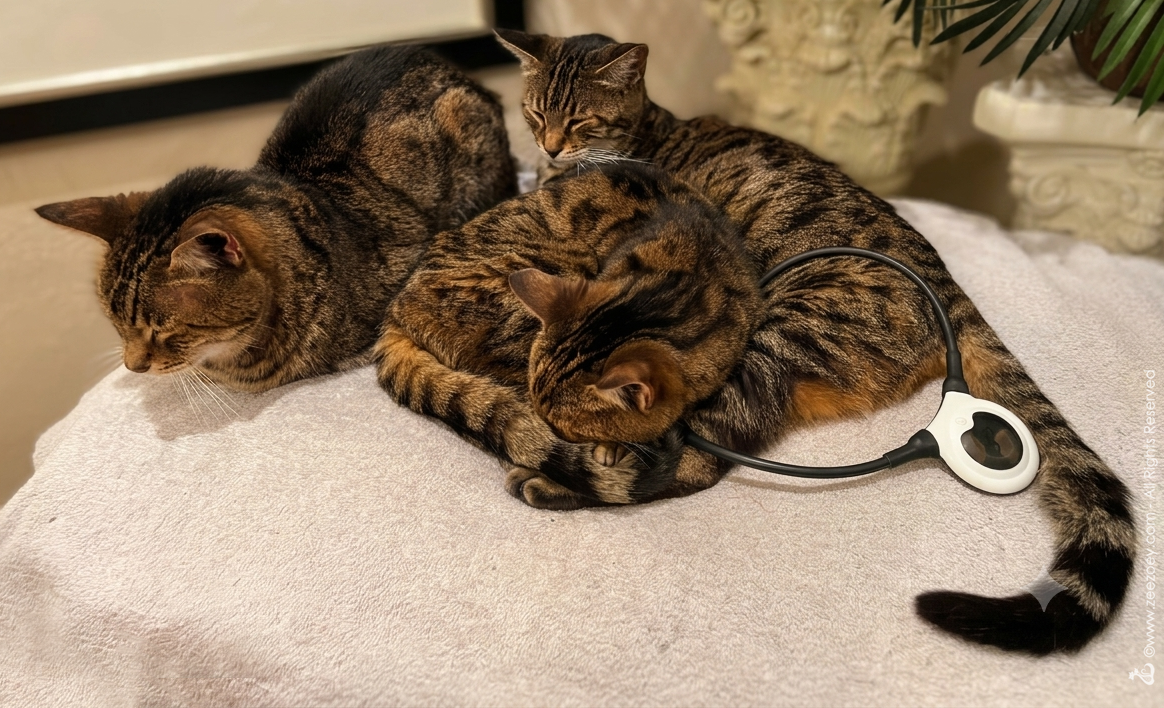
Rolz and Mia reporting for morning Assisi Loop detail!
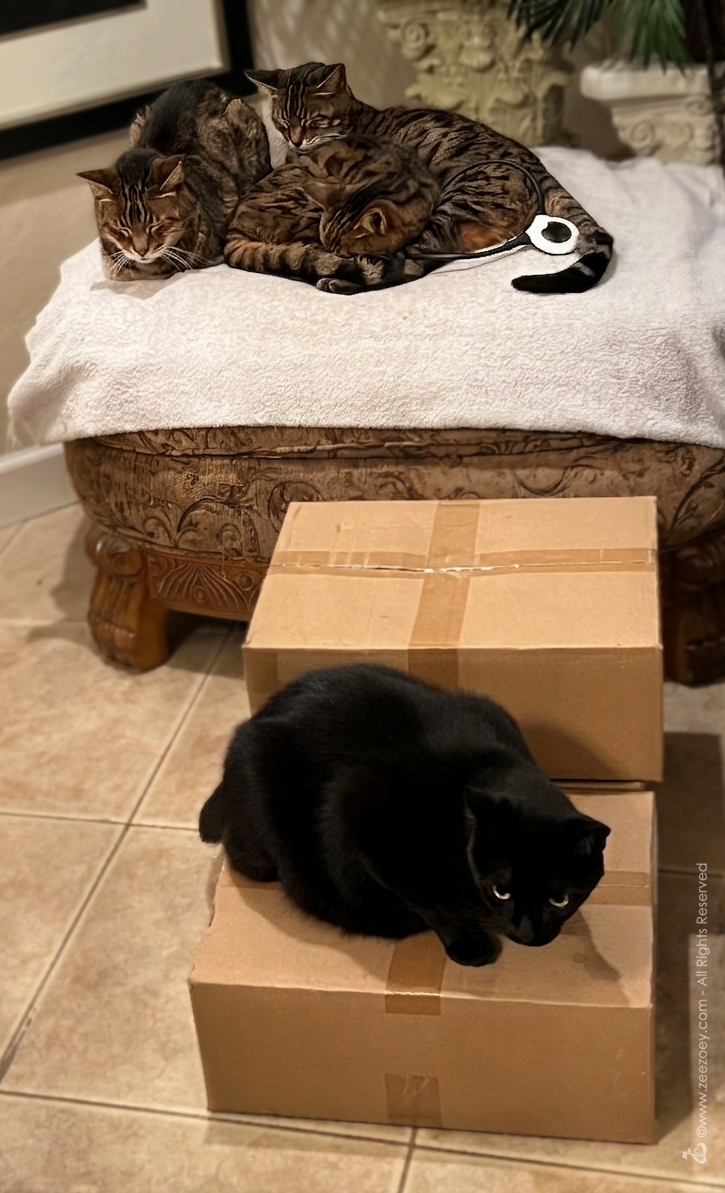
Shadow joining us this time – the top step is where I sit!
Her evening treatment happens out on the tiki deck. She relaxes completely, and I sit beside her, winding down from the day and catching up on the silly games on my phone. I cherish that one-on-one time with her. I also continue to supplement her meals with Cosequin and B12 (bumping her Cosequin dose up slightly from 2023), which has made a noticeable difference, although I do have to sprinkle her food with either a FortiFlora Probiotic supplement or Stella & Chewy’s Freeze-Dried Raw Magical Dinner Dust Chicken Topper because she will turn up her nose otherwise.
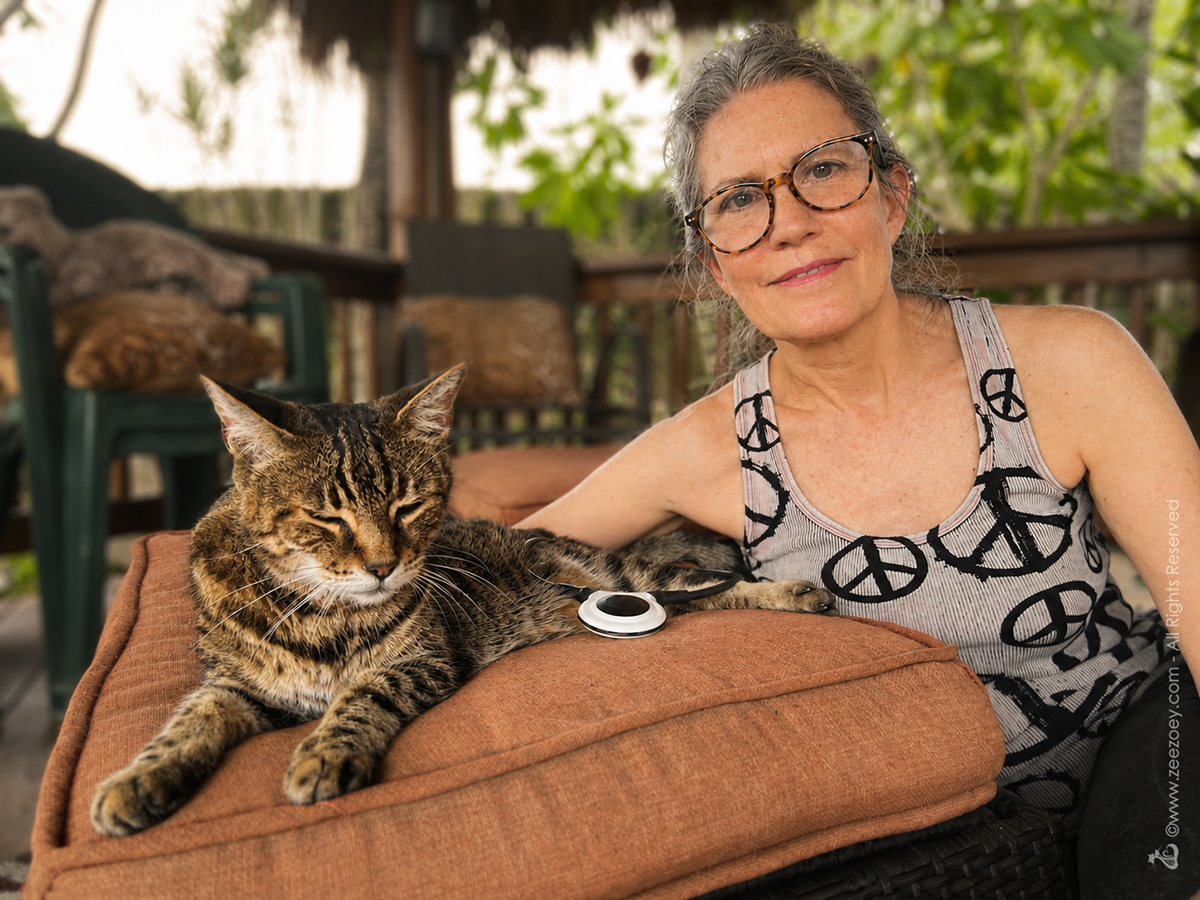
Peanut and I on the tiki for her evening Assisi Loop session
Considering none of us can stop the clock, I think she is doing wonderfully. I try to look at our home through her eyes and think about what I would want if I were in her paws. That perspective has changed everything: adding steps to her favorite spots, providing the heating pad, keeping up with the supplements, using the Assisi Loop, raising her food bowl so she doesn’t have to crouch to eat, using a low-entry litterbox, and scattering plush blankets on the floor for those times she just wants a quick rest without climbing.
Truly, this is wonderful advice for anyone who loves and cares for an aging cat, whether or not the cat has osteoarthritis.





The kitties and I are so happy that this this worked out so well for Peanut and for you and Dan, Deb! Cheers and Meows and purrs from us!
Thank you for the cheers, meows, and purrs!
I’ve always wondered about these. I’ve heard good things about them for a variety of painful conditions in cats. But like you said, it sounded gimmicky. Adequan made a huge difference in arthritis for Bear and Ellie Mae, but not all vets will prescribe it for cats (and those that do often prescribe it based on old information). I’m grateful you shared this!
I’m glad I could help, Kat. I’ve not heard of Adequan, but glad it provided relief for Bear and Ellie Mae.
So glad Peanut’s pain was managed so well! Hugs out to you both!
Thank you, Stephanie!
A friend has used the Assisi Loop on his cat and her predecessor, with very good results. I always opt for non-drug treatment, of myself and my loved ones, whenever possible. You probably know that Lil BUB benefitted from the Loop, too.
Wishing Peanut comfort, health, and LOVE!
Jmuhj, like you, I’m so relieved there was a non-drug option that worked. And how good to know that the loop was able to help Lil BUB in his day.
Although my kitty is still young, I always appreciate how you detail and research and explain your care so well. It’s amazing, and one knows it is not at all biased, but true. Thanks for sharing. And how heartening to read and know this is working well for your dear Peanut. Late in life issues are difficult to tackle, but you handle it with such competence and love and always also looking at it all from your kitty’s “perspective” which is so special! Bless you all … hoping for many more good days to come, Ann
Thank you for your kind words, Ann. With so many of us with senior cats, I felt it was important to share Peanut’s journey in a way that would be relatable to cat guardians. Clinical, or step-by-step articles serve a purpose, but nothing resonates more than a piece that comes from the heart.
I’m so glad your sweetie is doing mostly better, that’s wonderful!
Thank you Brian’s Home!! We appreciate your love.
Thanks for the share – I am so glad you found an appropriate treatment for Peanut (17 years? how can that be!) This info is going to help a lot of pet parents! 🙂
Thanks, Ramona. I do hope it helps pet parents. I want Peanut’s story to be a positive ray of hope for kitties with OA.
Glad it is helping her. A much better choice than the injection. Such a sweet family to help her with it. xo
They are such a sweet family, Ellen. It’s heartwarming to witness the love!
What an amazing device! I wonder if there are any studies on it with humans.
I have not fully researched the Loop for humans, but yes, I know it is available for human use.
Ernie had arthritis in his spine. Solensia did not help. But I did use the Assisi Loop on him and I really think it made a difference. Something else that helped when he had a particular bad flare up was acupuncture. Glad Peanut is getting relief with the Loop. I heard it can also help with things like IBD and even kidney issues.
I did not know it could be used for IBD and kidney issues, Island Cats. Thank you for letting me know, and I’m glad the Loop helped Ernie.