







Cats and Dogs – One Big, Happy Household #FoodShelterLove
This post is sponsored by Hill’s. I am being compensated for helping spread the word about Hill’s® Food, Shelter, & Love Program, but Zee & Zoey’s only shares information we feel is relevant to our readers. Hill’s Pet Nutrition, Inc. is not responsible for the content of this article.
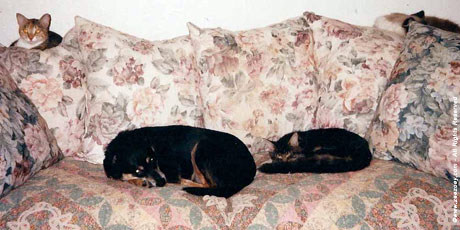
For as long as I can remember, I’ve lived in a house full of cats and dogs. What’s important to note is that I said a house full of cats and dogs in the plural sense. And I don’t just mean one dog and one cat – I’ve usually lived in a house with an average of 3 or more dogs and 3 or more cats together at the same time and most of them came to me as rescues through shelters. Why is this important to note? Because for many of you that have dogs, you think you can’t adopt a shelter cat or kitten because you automatically assume they won’t get along so you don’t even consider it.

When this picture was taken back in 1998, our household had 4 cats and 2 dogs. The secret to making it all work was the gradual, supervised introductions to one another. Seen here is Jazz as a kitten who was meeting Bandit and Bailey for the first time.
Well, I’m here to tell you along with Hill’s® Science Diet and Food, Shelter & Love® Program and the millions of cats and kittens waiting in shelters for that perfect family to adopt them, that with some practical advice and lots of patience, cats and dogs actually CAN HAPPILY LIVE IN THE SAME HOME with peace and harmony!
I can’t promise you it will always be easy, but through proper introductions, behavior training, veterinary care, and good nutritional food like Hill’s Science Diet Adult Sensitive Stomach and Skin to help cats reduce stress, it will eventually work out and the feeling that you get knowing you have saved the life of a shelter animal will far outweigh any of the possible tiffs, raised hairs, meows, and barks.
This picture was taken in 2008 and Bandit was so used to his cat housemates (Zee, Harley, and Jazz) that he looks like one of the feline gang! There is not an ounce of stress or trouble in the air.
Here are some of the key points I have learned throughout the years to help the acclimation process run as smoothly as possible. And keep in mind, while I currently live in a multi-cat only household, I do have grand-dogs that visit the house on a regular basis that interact with the cats and these tips work with them as well:
1. Resist the temptation to let the newly adopted cat meet the dog right away and give her a safe room to stay in that you can shut off from the dog, such as a spare bedroom. Make sure that you have a litter box, food and water dishes, toys, a scratching post, bedding, and a secure hiding area such as a cat tower.
2. Use scent transition for initial introductions by “swapping” scents. Take a clean towel and gently pet your cat’s cheek to transfer her pheromones onto the towel. Repeat the same procedure on the dog and place the respective towels where the cat and dog hangs out. Repeat this procedure for several days.
3. Take it slow and easy. Along with scent association, begin to gradually introduce the cat to the dog by opening the door a crack to let them sniff one another and STAY CLOSE BY TO SUPERVISE.
4. Let your cat have some peaceful explore time to gain confidence of her new surroundings by putting your dog in a spare room to let her sniff out a larger area of the house without fear of attack and keep the door open to her “safe place” in case she feels the need to run in for security.

This is my grand-dog, Rick, who was visiting for the Christmas holidays. You will note my cats Kizmet and Rolz also in the picture – they are perfectly at ease with Rick because I took my time introducing him to them and they also have a cat condo behind them if they feel the need to take high cover.
5. Set aside special bonding time with your dog who might be feeling jealous or neglected. Keep existing routines as normal as possible and remember that if they act out with hissing, barking, fighting, etc. that this is instinctive behavior that needs to be redirected, not punished for.
6. Give your cat access to high spaces such as shelves and cat trees to ensure she has a safe area away from the dog if she needs it.
7. Have all the household pets spayed or neutered – not only is it better for their health, but territorial and negative behavioral issues such as urine marking, spraying, and fighting can be greatly reduced.
8. Give your cat and dog separate feeding areas and be aware that they have their own unique nutritional needs for their current life stage to be happy and healthy. For more information about the full line of Hill’s pet food products available for your cat or dog, please click here.
9. Use treats and positive reinforcement for good behavior when the cat and dog are together. Just remember that the introductions will need to be controlled, gradual, supervised, and always positive. This can be done by placing your new cat in a carrier so that it will not provoke the dog or make the dog feel defensive. You can also put the dog on a leash and use favored rewards and training commands to encourage your dog to sit or stay calmly in the presence of the cat.
10. Respect the personalities, age, breeds, and circumstances of all animals before considering a lifetime commitment to adopt. For example, if you have an energetic puppy in the house, it would not be a good idea to adopt a cat with a serious illness or a disability.
With these tips and a lot of patience, before you know it, your dog and cat will be able to interact with one another and you will be living in a multi-pet household full of furry love. And best of all, you will have given one of the many millions of cats in a shelter a chance to live a happy and healthy life.
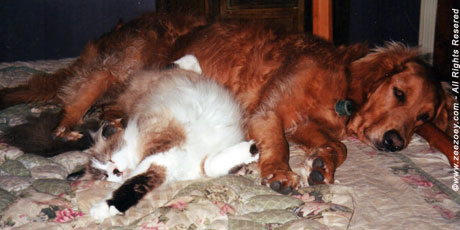
A picture is worth a thousand words and nothing conveys the love between cat and dog better than this one of Jazz sharing a nap with our rescue golden retriever, Lexi. Lexi came after Jazz, but the slow, gradual introduction phase between a multi-pet family is critical regardless of who comes first! This picture was taken in 2001.

The Hill’s Food, Shelter & Love® Program has currently provided over $240 million worth of food to nearly 1,000 shelters, 365 days a year helping over 6 million pets find a new home. It’s a living, breathing example of compassion based on these four pillars:
Volunteer – Hill’s encourages everyone to support their local shelters by spending time with shelter pets to help care for them and socialize with them.
Donate – Whether it be cash, toys, time, or supplies, shelters can always use donations and Hill’s can also help donors get connected with local shelters.
Choose -Helping pet parents everywhere learn more about the Hill’s shelter program and how choosing Science Diet® for their own pets can help thousands of shelter pets around the country.
Adopt – There are literally millions of cats and dogs in shelters up for adoption and the ultimate goal of the program is to bring some love home.





Very nice post. You are tempting me to get another dog. Ours passed away on 2011 and we are an all cat family now ( one turtle too) .
Oh goody, Ellen!! What fun if you get a new dog!!
The head peep says she doesn’t have time for a dog… and that a dog who came in here would be the most hen-pecked dog ever. Did she just call us chickens?
Yeah… dogs are a big commitment, Sometimes Cats Herd You. I would like one again one day…
I love that last photo, it’s so full of love!
The towel trick you talked about really does work, I use it. Believe it or not, lots of people thought I was nuts!!
or maybe i am and just don’t know it!
Silly Connie! You are not nuts – you are just full of love! Happy to know the towel trick works for you!
What a great post! For the longest time I didn’t think Davinia and Indiana were kitty friendly but it turned out they were just trying to play with them. It took a bunch of street cats for me to figure out what was going on. The dogs weren’t seen as threatening or upsetting to the neighborhood cats in fact they would follow us on walks in the evening and even rub themselves against the dogs and Davinia and Indiana could care less. It was only if the cats came close and ran away that the girls wanted to give chase because they thought it was a game. We have been able to foster a litter of kittens with their momma and a solo kitten and not only did the girls not care Davinia wanted to mother the kittens.
Felissa – that’s how it is at our house when Rick comes to visit. If the cats happen to run, it startles him and he thinks they are playing a game!
guys…..de food serviss gurl wood have a bulldog ina fast minit….de food serviss gurl better
reel eyez de toona master sayz…..wait….just….a…..minit !!! ♥♥ 🙂
tabbies – I think you would happen to love a dog… they are way, way better than a darn BURD, that’s for sure!
Great piece. Introducing a new pet always takes time and patience!
Absolutely Rosemary! Time and patience are at the top of the list!
Great post. I met some of my neighbor’s dogs and it didn’t turn out good for them as you can imagine.
Hmmm… just what did you do, CK?
Good job examining all of the issues involved in introducing cats and dogs—well-said and encouraging! And a hearty thank-you to Hills for all the good work they do to help shelter pets! #FoodShelterLove !
Thank you Joan – I’m glad you found the article to be encouraging – lets hope between all this great information and some help from Hills, that a lot more kitties find furever homes!
It sounds like introducing a cat to a dog is no different than introducing two cats or two dogs. Though we still don’t want a dog living with us. 😉
It is very similar, Island Cats, but it is duly noted that you don’t want a dog living with you!
Love to see you family expanding! Stopping by from the WW hop, come say hi 🙂
Glad you enjoyed, Talent Hounds! Thanks for stopping by!
What a great program and I am so glad to hear how our beloved animals can be helped.